I’ll never forget the Tuesday night I sat on my bathroom floor, tears pricking my eyes, frantically scraping a gooey, chemical-tasting strip off my front teeth. I’d seen the commercials. I’d bought into the promise of a “professional smile” for the price of a pizza. But instead of radiance, I had zingers of pain shooting through my jaw and gums that looked like I’d just chewed on a habanero pepper. It was my third box of strips in two months, and my teeth weren’t getting whiter—they were just getting more sensitive. That was my “lightbulb moment.” I realized I was stuck in a cycle of spending money on products that weren’t designed for my unique mouth.
Stop Wasting Money on the Drugstore Aisle
We’ve all been there, standing in the pharmacy aisle, squinting at the fine print on twenty different boxes. You want a brighter smile, but the price tag for expert cosmetic dentistry solutions feels daunting compared to a $35 kit. I’m here to tell you what I wish someone had told me years ago: not all whitening is created equal. Today, I’m going to pull back the curtain on why those strips often fail and how professional-grade gels actually work to lift deep-seated stains. We’re going to solve the mystery of “splotchy” whitening and find a path to a brighter smile that doesn’t leave your teeth feeling like they’re vibrating every time you breathe in cold air. If your goal is to truly revamp your smile, you have to look past the pretty packaging.
Is the professional price tag actually worth the hype?
I get the skepticism. I really do. When I first started looking into dental care, I thought the professional stuff was just a marketing ploy. I even made the mistake of thinking charcoal toothpaste would fix my coffee stains, which only ended up thinning my enamel. The truth is, the primary difference is concentration and delivery. Store-bought strips typically use a low concentration of hydrogen peroxide (usually around 6-10%), while professional gels applied by a dentist can range from 25% to 40%. According to the American Academy of Cosmetic Dentistry, professional whitening performed under supervision ensures that the bleaching agent stays on the teeth and off the sensitive soft tissues, which is exactly where I went wrong. Have you ever felt that sharp, “lightning bolt” pain after using a whitening strip and wondered if you were doing permanent damage? You aren’t alone.
The Science of Why Strips Can’t Reach Deep Stains
The problem with strips isn’t just the strength; it’s the fit. Your teeth are three-dimensional, but strips are flat. This leads to the “yellow edges” look because the strip can’t wrap into the crevices. If you have dental crowns or existing composite tooth-colored fillings, those strips won’t change their color at all, often leaving you with a mismatched smile that looks worse than when you started. Choosing a professional route often involves custom-fitted trays that ensure every nook and cranny is covered, which is a core part of a comprehensive family dentistry guide. By understanding how these chemicals interact with your biology, we can finally stop the guessing game.
Why Your Smile Needs a Perfect Seal Instead of a Flat Strip
To understand why professional whitening works, imagine trying to paint a picket fence with a wet rag—you’ll hit the flat parts, but the cracks stay dark. Whitening strips are the wet rag. Custom-molded trays, however, are like a precision spray gun. They hold the gel against every curve of your teeth, preventing saliva from washing the formula away and, more importantly, keeping the bleach off your gums. When I finally sat in my dentist’s chair for impressions, I was terrified of more pain. But the moment those custom-molded trays snapped into place, I realized I’d been doing it all wrong. Unlike the strips that slid around and leaked gel into my throat, these trays felt like a second skin. I wore them for an hour while watching a movie, and for the first time, my gums didn’t throb.
Stop Scrubbing and Start Oxygenating Deep Stains
Many people think they need to scrub stains away, which is why they turn to abrasive DIY hacks that cause permanent damage. Real whitening isn’t about friction; it’s about oxygen. Professional gels use high-concentration peroxide to release oxygen molecules that dive deep into the porous enamel to break apart the chemical bonds of a stain. This is the most effective way to whiten teeth with deep coffee stains because it addresses the internal color, not just the surface. If you’ve spent years drinking espresso or red wine, surface-level strips won’t touch the dentine layer where the real yellowing lives. If you are worried about the integrity of your teeth, you should look for the safest way to whiten teeth if you have thin enamel to avoid making sensitivity worse.
The Secret to Getting Results Without the Zingers
The zingers I used to feel were caused by the tubules in my teeth being exposed and dehydrated. Professional systems often include desensitizing agents like potassium nitrate or fluoride right in the gel. This blocks the pain signals before they start. If you’ve already overdone it with the drugstore kits, knowing the best way to soothe sensitive teeth after a whitening session is a lifesaver. It’s also vital to remember that whitening only works on natural tooth structure. If you are debating between dental crowns vs other restorations, you need to plan your whitening beforehand. A crown won’t change color, so if you whiten your teeth later, your crown will stand out like a yellow thumb in a white field. To stay ahead of the curve, keep an eye on cosmetic dentistry innovations to watch, as new formulas are becoming even more effective at balancing speed with comfort.A common belief in the waiting room is that cosmetic dentistry is strictly about vanity. I used to think that way too, until I realized that a beautiful smile is usually a byproduct of a healthy foundation. When we talk about the role of family dentistry in ensuring oral health for all ages, we aren’t just talking about routine cleanings; we’re talking about structural integrity. The biggest mistake I see is people waiting until a tooth literally splits in half before they consider a crown. They view it as a ‘last resort’ when, in reality, understanding dental crowns and why they are needed early on can save you from an emergency root canal down the road.
Why your crown isn’t just a fancy cap
Most people believe that once a crown is on, the tooth is ‘invincible.’ This is a dangerous myth. The tooth underneath is still susceptible to decay at the margin where the porcelain meets the natural tooth. If you don’t maintain a strict family dentistry guide for hygiene, you can develop a ‘leaking’ crown. Another specific trap is the ‘dark line’ issue. I’ve had friends complain about their smiles looking ‘fake’ after just a year. If you are wondering why your porcelain crown has a dark line at the gum line, it is often due to the metal substructure of older PFM crowns being exposed as gums naturally recede. Modern zirconia options eliminate this, but many patients don’t know to ask for them.
Avoid the big filling trap before it is too late
I’ve seen so many people ask for a ‘large filling’ to save money, but this is a classic ‘oops’ factor in dental care. A large filling doesn’t provide structural support; it actually acts like a wedge, putting pressure on the remaining walls of your tooth every time you chew. Eventually, the tooth fractures. Choosing the right path requires comparing dental crowns vs other restorations to see which actually preserves your long-term bite.
Should you choose a crown over a different restoration?
This is the question that separates basic care from advanced dental strategy. According to a study published in the Journal of Prosthetic Dentistry, the longevity of a restoration is directly tied to the amount of healthy tooth structure remaining. If more than 50% of your tooth is gone, a filling has a significantly higher failure rate than a crown. Furthermore, if you are constantly searching for the real reason your porcelain crown keeps chipping, the culprit is rarely the porcelain itself. It is usually your ‘occlusion’—how your teeth meet. If your dentist doesn’t account for your night-time grinding or your jaw alignment, even the most expensive crown will fail. Have you ever fallen into this trap of choosing a temporary fix over a permanent solution? Let me know in the comments.
Maintaining the results of your treatment is where most people drop the ball. I used to think a simple toothbrush was enough, but after getting my first crown, I realized the ‘margin’ is the most critical area of your oral health. If you don’t keep that tiny line where the porcelain meets the gum perfectly clean, you’re basically inviting decay to hide under your expensive work. This is why I swear by a high-quality water flosser. However, if you’re new to the tool, you should learn how to stop your gums from hurting when you use a water flosser because cranking it to the highest setting on day one is a recipe for bleeding. I also keep a stash of interdental brushes in my car; they are far more effective at clearing the space under a bridge than standard floss ever could be.
Keep your new smile from becoming a memory
The real secret to making your dental work last twenty years instead of five is staying proactive. When I first heard about dental crowns explained as the ultimate solution for damaged teeth, I didn’t realize that their longevity depended entirely on my night-time habits. A study published in the Journal of Oral Rehabilitation found that patients with untreated bruxism (teeth grinding) have a significantly higher rate of ceramic fracture compared to those using a custom night guard. If you find yourself wondering why your jaw aches every time you wake up in the morning, you are likely putting thousands of pounds of pressure on your restorations while you sleep. A simple protective barrier can be the difference between a crown that lasts decades and one that chips in months.
How do I maintain my dental work over time?
The answer is a mix of technology and technique. Beyond the water flosser, I recommend a pressure-sensing electric toothbrush. These tools prevent you from scrubbing away your enamel, which is vital if you want to avoid the recession that leads to that unsightly dark line at the gum line. You also need to be vigilant about the seal of your restorations. Learning how to tell if your dental crown is leaking bacteria can save you from a massive infection that might require an extraction. If you feel a sweet sensitivity or a strange ‘metallic’ smell, don’t wait for your six-month cleaning. Get it checked immediately to ensure the internal tooth structure remains sound.
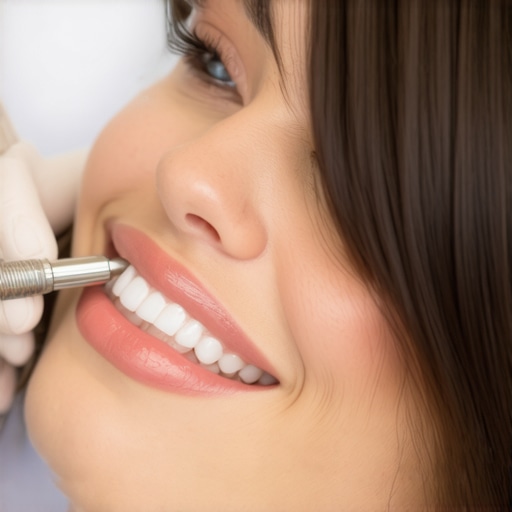
Why high-tech scans are the new gold standard
Looking toward the future, the ‘gooey’ impressions we all hate are becoming a thing of the past. This is a massive win for accuracy. I’ve learned that why your dental implant specialist needs a high-tech scan isn’t just about cool gadgets; it’s about mapping your bone density and nerve locations with sub-millimeter precision. I predict that within the next five years, AI-driven diagnostics will be a staple in every family dentistry guide, allowing doctors to catch microscopic cracks before they even show up on a traditional X-ray. We are moving toward a ‘prevention-first’ model where cosmetic dentistry innovations to watch will focus as much on the biological integration of materials as they do on the aesthetics. My advanced tip for you today: next time you’re in the chair, ask your dentist if they use digital impressions like the iTero scanner. It provides a much more accurate fit for crowns and aligners, reducing the need for ‘adjustments’ later on. If you haven’t had a check-up in a while, it’s time to contact us and see how these new tools can protect your investment.
The Hard Truths I Learned While Navigating Dental Upgrades
Reflecting on my own journey, there are a few lightbulb moments that completely changed how I approach my oral health. First, I discovered that shade-matching a crown is an art form; you want a color that mimics the natural translucency of your real teeth rather than a flat, monochromatic white. Second, I realized that dental crowns explained as a ‘final solution’ only stay final if you address why the tooth failed in the first place—usually due to grinding or neglected hygiene. Lastly, I learned that a beautiful smile is a team effort. You provide the daily maintenance, and your dentist provides the structural expertise.
The Hand-Picked Tools That Keep My Smile Bright
I don’t just rely on luck; I rely on a specific set of tools that have kept my restorations in peak condition. I personally recommend a high-quality water flosser for anyone with bridgework or crowns. If you’ve struggled with discomfort, learning how to stop your gums from hurting when you use a water flosser is the best first step. I also trust resources from the American Academy of Cosmetic Dentistry for staying updated on safe materials. For those looking to revamp your smile effectively, these daily habits are just as important as the professional treatments themselves. #IMAGE_PLACEHOLDER_E#
Embrace the Confidence of a Healthy Radiant Smile
Choosing to invest in your teeth is about more than aesthetics; it is an investment in your self-esteem and your long-term health. Whether you are considering expert cosmetic dentistry solutions or just looking to improve your routine, the best time to start is today. Don’t wait until you’re in pain to prioritize your dental health. Every small change you make now contributes to a lifetime of confident smiles. What has been your biggest challenge when it comes to keeping your teeth white or healthy? Let me know in the comments below.