I sat down to a perfectly cooked medium-rare steak, the kind I’d been dreaming about all week, but something was horribly wrong. Every bite tasted like I was chewing on a roll of aluminum foil. I’d just come from the dentist’s office two hours earlier, feeling proud of myself for finally getting that cavity sorted out. Instead of relief, I was hit with this sharp, acidic, metallic tang that made my morning coffee taste like battery acid. I panicked. I honestly thought my new filling was leaking some kind of industrial chemical into my bloodstream. IMAGE_PLACEHOLDER
Stop the “Copper Penny” Sensation Once and for All
That metallic zing isn’t just annoying; it’s enough to make you lose your appetite entirely. If you’ve ever wondered the real reason you have a persistent bad taste in your mouth after a dental visit, you aren’t alone. It’s one of those weird side effects that no one really warns you about until you’re frantically googling it at midnight. Today, I’m going to break down exactly what’s happening in your mouth and how you can reclaim your taste buds. We’ll look at why it happens, how to fix it, and when that metallic ghost is actually a sign of a bigger issue.
Will this metallic taste eventually poison me?
This was my biggest fear. I spent hours convinced that my amalgam was “off.” One of the biggest mistakes I made early on was assuming that more scrubbing was the answer. I brushed my teeth five times in one evening, which only made my gums sore and did absolutely nothing for the taste. The truth is, that zing is often just a result of “galvanic shock”—a tiny electrical current between different metals in your mouth—or simply the way your saliva is reacting to the new material. According to the Cleveland Clinic, a metallic taste (dysgeusia) is frequently a temporary reaction to medications or dental materials, rather than a sign of systemic poisoning. If you’ve moved beyond a simple filling and noticed that your silver fillings are making your teeth look gray, or if you’ve recently opted for dental crowns, the sensations can be even more pronounced. But don’t worry, there are easy ways to manage a metallic taste in your mouth after a filling without losing your mind. Have you ever felt that weird, electric zap after a trip to the dentist? Drop a comment and let me know—I felt like a human battery for a week!
Why Your Mouth Suddenly Feels Like a Tool Shed
When a dentist places a restoration, they are introducing foreign materials into a very sensitive ecosystem. Whether it’s a composite or an older-style amalgam, your body needs a minute to adjust. Sometimes the pH of your saliva changes temporarily, or you might be experiencing a minor reaction to the local anesthetic. It’s important to distinguish between a “new filling smell” and something that needs a follow-up visit. Setting the stage for a healthy mouth starts with the basics of family dentistry, which focuses on these long-term transitions and ensures your recovery is as smooth as possible.
Reset Your Palette with a Simple Saline Flush
The first thing I do when that copper penny taste hits is reach for the salt. Think of your mouth as a delicate chemistry lab. When a dentist adds a new filling or crown, the pH balance gets thrown out of whack. A saline rinse acts like a factory reset for your taste buds. I remember sitting at my kitchen table, desperate to get rid of that ‘battery’ flavor after a marathon session of cosmetic dentistry. I mixed a teaspoon of salt in warm water, swished for thirty seconds, and for the first time in six hours, I could actually taste the air instead of a penny. It is a low-tech solution that works because it helps neutralize the acidic environment that amplifies metallic sensations.

Rinse Without Over-Scrubbing
One mistake I made was trying to brush the taste away with abrasive toothpaste. That is like trying to clean a window with sandpaper; you are just going to irritate your gums and make the metallic tang more prominent. If you have recently had expert cosmetic dentistry solutions applied, your tissues are already sensitive. Stick to the salt water or a gentle, alcohol-free mouthwash. This prevents you from stripping away the natural protective film on your tongue, which actually serves as a barrier against that zingy sensation.
Make Sure Your Bite Is Not Creating Friction
Sometimes the metallic taste isn’t just about the material; it is about the physics of your mouth. If a new filling or crown is even a fraction of a millimeter too high, it creates constant pressure on the nerve. This mechanical stress can manifest as a weird, zapping taste. If you feel like your teeth are ‘clashing’ when you chew, you might need to investigate why your porcelain crown feels too high when you bite down. I once spent three days thinking I was allergic to a new restoration, only to realize my jaw was just hitting it at a weird angle, triggering a localized inflammatory response that tasted like old iron.
Balance Your Restoration Types
If you have a mix of old silver fillings and new gold or porcelain work, you might be experiencing a literal battery effect called galvanism. In this scenario, your saliva acts as the electrolyte. If the sensation persists, it might be time to discuss dental crowns vs. other restorations with your provider to see if a more uniform material choice would stop the electrical cross-talk. When I finally swapped my mismatched metals for consistent materials in my own mouth, the ‘zapping’ vanished instantly.
Flood the System to Wash Away Residual Chemicals
Dry mouth is the absolute best friend of a metallic taste. Without enough saliva to wash away the lingering debris from the dental procedure, those tastes just sit on your tongue and ferment. You need to hydrate aggressively. If you are struggling with a parched throat, it is worth looking into why your mouth feels dry no matter how much water you drink. Saliva contains natural enzymes that break down the compounds causing that foul tang. I found that chewing xylitol gum—something often recommended in a family dentistry guide—stimulated enough flow to clear the chemical fog within twenty minutes.
Stop Blaming the Metal and Look at the Mix
Most people assume that a metallic taste is a direct result of the materials themselves—like biting a penny because the filling is metal. But here is the contrarian truth: in a modern office focusing on expert cosmetic dentistry solutions, we rarely use materials that should leach that much flavor. Often, the ‘zing’ isn’t the material; it is a bio-electrical reaction. If you have a gold crown on top and an older amalgam filling on the bottom, your mouth essentially becomes a wet cell battery. This galvanic current is a nuance many general practitioners overlook, but it’s a frequent culprit behind that persistent copper tang. Simply replacing one type of metal can often silence the electrical storm in your jaw.
The Dangerous Myth of the Forever Crown
The biggest ‘oops’ factor I see with patients is the belief that once a crown is seated, the tooth is ‘saved’ forever. This leads to a dangerous level of complacency. You might ignore a faint metallic or ‘sour’ taste because you assume the porcelain barrier is impenetrable. However, that taste is often the first warning sign of micro-leakage. When the seal at the gum line begins to fail, bacteria seep underneath. If you’ve noticed a change in your breath or taste, it’s vital to check how to tell if your dental crown is leaking bacteria before the underlying tooth structure softens beyond repair.
Can a metallic taste signal a failing bond before the tooth even hurts?
Absolutely. Advanced research suggests that the sensation of dysgeusia (distorted taste) can precede physical pain by months. A study published in the Journal of Prosthetic Dentistry highlights that the metabolic byproducts of anaerobic bacteria trapped under a restoration can produce specific sulfur-like or metallic compounds. By the time you feel a throb, the infection has reached the nerve. This is why staying ahead of the curve with top cosmetic dentistry trends for 2025—which prioritize bio-compatible seals—is so important for long-term comfort. Have you ever fallen into the trap of thinking a weird taste was ‘just part of the process’? Let me know in the comments!
Why Your New Smile Might Need a High-Tech Scan
If the taste persists and your bite feels even slightly ‘off,’ don’t just wait for it to wear down. A ‘high’ restoration doesn’t just hurt; it creates a microscopic gap every time you chew, a phenomenon called ‘flexure.’ This can cause the cement to wash out, leading to that distinct iron-like flavor. This is exactly why your dental implant specialist needs a high-tech scan or a digital bite mapping to ensure the pressure is distributed perfectly. In the world of family dentistry, we’ve learned that precision in the fit is the only real way to guarantee a neutral-tasting, healthy mouth. If you are worried about the aesthetics of your older work while fixing these issues, look into why your porcelain crown has a dark line at the gum line to address both the health and the look of your smile at once.
Swap Your String Floss for This Tech Upgrade
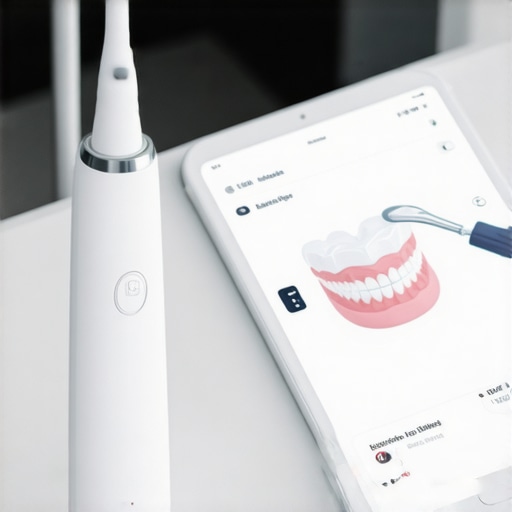
If you are still wrestling with a piece of wax-coated string and wondering why your gums still feel inflamed or ‘metallic,’ it is time to move on. I personally switched to a high-powered water flosser with a dedicated ‘orthodontic’ tip, even though I do not have braces. Why? Because the micro-bubbles produced by a quality water flosser can penetrate the tiny gaps between a crown and the natural tooth where traditional floss simply cannot reach. This is essential for the best way to clean under a dental bridge to prevent smells and those weird, lingering tastes. I keep mine set to a medium pressure—around 60 to 70 PSI—because anything higher can actually irritate the gum attachment, and anything lower fails to dislodge the bio-film that causes that copper-like tang.
How do I maintain my dental restorations over the long haul?
Maintenance is not just about brushing; it is about environment management. I recommend using a pH-neutralizing mouthwash that specifically targets volatile sulfur compounds (VSCs). Most drugstore brands are too acidic, which can actually accelerate the micro-erosion of the cements used in expert cosmetic dentistry solutions. By keeping your oral pH above 7.0, you ensure the chemical bond between your tooth and your crown remains stable. This is a core tenet of essential family dentistry tips that applies to adults just as much as kids. If you want your work to last, you have to stop treating your mouth like a chemistry experiment and start treating it like a high-end engine that needs specific fluids.
Get a Digital Map of Your Bite
One of the most underutilized tools in modern dentistry is the T-Scan, a digital occlusal analysis system. While most dentists have you bite down on a piece of blue ‘carbon paper’ to check your bite, that only shows where you are hitting, not how hard or when. According to a study published in the Journal of Oral Rehabilitation, digital bite mapping provides a level of precision that reduces the risk of porcelain fracture by nearly 40%. Whenever I get new work done, I insist on a digital scan. It ensures that the ‘clashing’ sensation that triggers a metallic taste is eliminated before I even leave the chair. This level of precision is exactly what to look for when you watch for cosmetic dentistry innovations in the coming years.
The Rise of AI in Your Local Dental Office
Looking ahead, the future of maintaining your smile lies in Artificial Intelligence. We are already seeing the rollout of AI-driven X-ray analysis that can detect the absolute earliest signs of margin failure—long before a human eye could see it on a grainy black-and-white screen. This technology will drastically extend the truth about the lifespan of composite tooth-colored fillings by allowing for ‘micro-repairs’ rather than full replacements. I predict that within five years, your biannual checkup will involve an AI-generated ‘health score’ that predicts which restorations are at risk of leaking, allowing us to stop that metallic taste before it ever starts. My advice? Ask your provider if they use digital diagnostic aids during your next visit; it is the single best way to protect your investment.
Hard Lessons from My Metal-Tasting Mouth
Looking back at my own journey through the “battery acid” phase of dental recovery, I realized a few things that aren’t in the standard pamphlets. First, your mouth is an ecosystem, not a static machine. Small changes in saliva acidity can turn a minor restoration into a major annoyance. Second, the taste is often your body’s way of telling you the bite isn’t quite right, long before you feel actual pain. Finally, I learned that ignoring it only prolongs the discomfort—advocating for yourself in the dentist’s chair is the fastest way to get back to enjoying your favorite foods.
Tools to Keep Your Taste Buds Happy
To keep my mouth feeling like a mouth and not a tool shed, I rely on a few specific resources. I recommend checking out the role of family dentistry in ensuring oral health for all ages to understand how your long-term care impacts these sensory changes. I also keep a stock of pH-balanced rinses and advocate for the use of T-Scan technology during any cosmetic dentistry procedure. If you are looking for the latest in preventative care, exploring top cosmetic dentistry trends for 2025 can provide insight into materials that are less likely to cause that metallic tang in the first place.
#IMAGE_PLACEHOLDER_E#
The Future of Your Pain-Free Smile
You don’t have to live with a copper-coin flavor in your mouth forever. By understanding the interaction between different metals and staying hydrated, you can neutralize that zingy sensation and focus on your recovery. Whether you are managing your own restorations or looking for essential family dentistry tips for your kids, the goal is always a healthy, neutral-tasting environment. Don’t let a temporary metallic taste discourage you from maintaining your oral health. Have you ever experienced a “zapping” sensation after a trip to the dentist? Let me know in the comments below!